


Wakayama Prefecture's first oyster farming for raw consumption

The oysters produced by Tatei Suisan are a specialty product of Kainan City.
It was certified by Kainan City , Wakayama Prefecture in January 2019.
Shiozu is located in Wakayama Bay in northern Wakayama Prefecture, situated between the Kinokawa and Arita Rivers, representative rivers of Wakayama Prefecture that carry abundant nutrients from the mountains of the Kii Peninsula into the sea. Aquaculture is carried out in the sea, which is rich in nutrients as the tides rise and fall.
・・Cultivation method・・
We primarily use longline farming methods set up in the open ocean where nutrient-rich currents flow into the Kii Channel. During the juvenile stage, we cultivate oysters on rafts in calm bays, changing the location, depth, and cultivation methods according to their growth and the season, allowing us to raise oysters throughout the year.
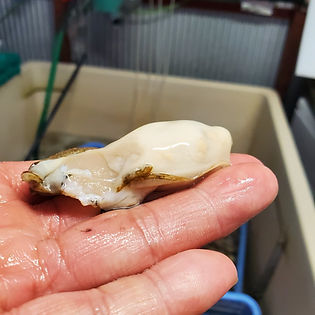
**Reasons why small, one-year-old oysters are preferred**
Although the oysters are smaller due to the short cultivation period, compared to the large oysters commonly eaten in Japan (oysters cultivated for two years or more), the oysters grown here in Shiozu are smaller but plump, with a strong sweetness and rich umami flavor.
Even people who don't like oysters often enjoy them, saying that the umami flavor is stronger than the oyster's characteristic taste.
Food culture: grilled or raw
In Japan, where cooking methods such as grilling, steaming, and hot pot are the norm, large oysters that have been cultivated for over two years are used to prevent them from shrinking due to overcooking. However, in other countries, where raw eating is the norm, large oysters are difficult to eat in one bite, and people tend to savor different parts of the oyster. Therefore, one-year-old oysters, which are small enough to be enjoyed in one bite and have no unpleasant taste or smell because they have not released sperm or ovulated, are preferred and consumed.
In Japan, the production of oysters for raw consumption is increasing, and more and more customers are choosing one-year-old oysters, which are recommended for raw consumption, not only for their size but also for the difference in taste depending on the local waters.
Why do people put lemon on raw oysters?
Oysters contain lactic acid and succinic acid, which are called "warm-flavoring organic acids" and become more delicious at warm temperatures, so they are perfectly tasty even when cooked as is.
However, since raw vegetables are eaten at a cold temperature, the "warm-flavored organic acids" cannot be fully utilized.
This is because the citric acid contained in lemons is a "cold-flavoring organic acid," and the synergistic effect of glycogen, the source of umami found in oysters, with citric acid eliminates any unpleasant odor while doubling the umami flavor.
Nutritious oysters make a great gift for women!
Oysters provide 18 types of amino acids, vitamins (A, B1, B2, C), minerals (zinc, iron, calcium), glycogen (glucose), and taurine (a type of amino acid), offering three beauty benefits that are especially appealing to women.
1. Abundant zinc creates healthy and beautiful skin.
Zinc is essential for beautiful skin, and oysters are rich in zinc, containing 3 to 5 times more than pork. 💗
Zinc is an ingredient that can be expected to improve skin roughness, have anti-aging effects, and reduce blemishes by activating cell division, promoting skin regeneration, and normalizing cell turnover.
2. Balance hormone levels
Zinc has the effect of activating hormone secretion and is significantly involved in the production of female hormones.
3. It is packed with skin-beautifying ingredients such as amino acids and vitamins.
It is rich not only in zinc and minerals, but also in amino acids and vitamins. Amino acids such as glycine and alanine make up 40% of the natural moisturizing factors (NMF), which help maintain skin moisture and health.
Furthermore, it is particularly rich in B vitamins, which help to balance the body's natural balance and improve skin problems.
Oysters have been found to be inextricably linked to beauty, and are considered good for men as well. There are even reports from the medical community suggesting that eating one oyster a day can reduce the risk of contracting COVID-19.
Oyster shells are used to improve water quality, and are also used as materials, fertilizer, plaster, and construction materials; nothing goes to waste.

Representative: Tatsutoshi Abe
33 years of experience as a fisherman (line fishing and oyster farming)
I'm posting this instead of my usual blog.
*Giving back to the mountains for the blessings of the sea*
Oysters grow by consuming nutrient-rich mountain produce carried down the river.
Now, we're giving back to the mountains with the bounty of the sea using oyster shells!